
What to Bring, What to Leave, and What to Commission: Art for the Next Chapter
The most consequential art decisions of a senior living transition are rarely made by a curator. They are made in an afternoon, under pressure, by a family that has not been given the right framework to think them through.
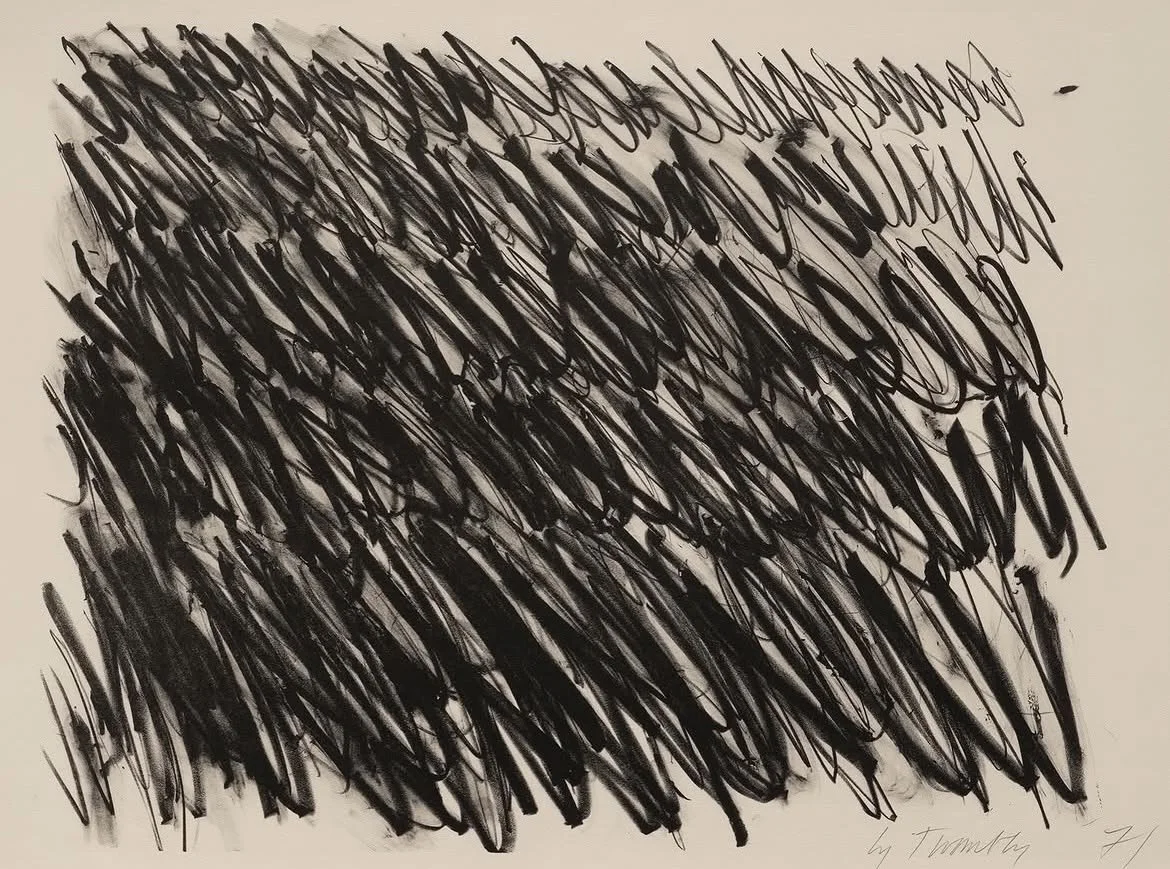
Look at the Twombly above for a moment. The furious diagonal energy of the mark-making, the way the lines accumulate into something that is simultaneously chaotic and completely controlled, the numbered edition visible at the lower right corner — 7/1 — confirming that someone, at some point, chose this particular impression from this particular printing. That choice is itself a form of autobiography. To own a Twombly is to have made a decision about what kind of visual energy you want to live with, what register of feeling you want present in the room each morning.
That is what is at stake when a family faces the question of what to do with art during a senior living transition. Not logistics. Not storage. Identity.
A senior living transition asks many things of a family simultaneously — logistical, emotional, financial. In the midst of it, the question of what to do with decades of collected art tends to be resolved by default rather than by design. Pieces are distributed to adult children who may not want them, placed in storage where they are rarely retrieved, or left behind in a home being prepared for sale. The result, more often than not, is that the resident moves into a new space with bare walls — or worse, walls decorated by someone else's taste.
This is a failure of process, not of intention. The families Saar Advisory serves understand that art is not furniture. It is memory made visible. It is the record of a life's aesthetic commitments — the Hockney lithograph acquired on a trip to London in the eighties, the small oil portrait of a beloved dog, the signed Chagall print that has hung in every home since the first one. These objects carry a density of meaning that no replacement can replicate.
The solution is a structured curatorial conversation — one that happens before the move, not during it, and that applies the same deliberate intelligence to the collection as to every other aspect of the transition.
THE FRAMEWORK: THREE CATEGORIES, ONE CONVERSATION
Every collection, regardless of its scale or monetary value, can be organized into three categories when approaching a transition. The discipline of working through all three — rather than making ad hoc decisions under deadline — is what protects both the collection and the resident’s sense of continuity.
CATEGORY ONE
What comes with you
Works with the strongest personal resonance, scaled appropriately for the new space, and suited to the emotional register of daily life in that environment.
CATEGORY TWO
What is placed with intention
Works that are meaningful but not suited to the new space — gifted to family members, loaned to institutions, or placed in documented storage with a clear plan for their future.
CATEGORY THREE
What is commissioned new
Works created specifically for the new chapter — to fill a visual gap, to mark the transition itself, or to add something the collection has never contained but the resident has always wanted.
The first category is where most families focus, and rightly so. But the second and third deserve equal care. A piece placed with a grandchild because it is right for them — presented with its provenance, its story, its emotional context — becomes an heirloom in the fullest sense. A commissioned work, created in response to where a person is now rather than where they have been, can be among the most meaningful objects in a life.
WHAT TO BRING: THE SELECTION CRITERIA
The private room or suite in a luxury RCFE or independent living community is an intimate space. It is, typically, smaller than the primary residence it follows. This is not a diminishment — it is an invitation to radical curation. Every work on the wall will be seen every day, from specific vantage points, in particular light. The standard is higher, not lower.
Several questions guide the selection process:
Does the scale serve the space? A large-format canvas that commanded a great room will overwhelm a private suite. Conversely, works that were lost on expansive walls may finally come into their own in an intimate setting. Scale is not merely a matter of measurement — it is a relationship between the object, the room, and the viewer at rest.
Does the emotional register serve daily life? This is the question the Twombly asks with particular force. A work that is intellectually demanding — that requires the viewer to meet it with sustained attention — may not be the right companion for a space meant for rest and ease. The works that belong in a bedroom or sitting area are those that give generously, that the eye returns to with pleasure rather than obligation. Van Gogh's late garden paintings. A Matisse interior. The quiet geometries of a Josef Albers study. Works that reward daily proximity without exacting it.
"The works that belong in an intimate space are those that give generously — that the eye returns to with pleasure rather than obligation."
A Twombly, by contrast, belongs in a space where a resident has the energy and the inclination to engage with its tension — a study, a sitting room with good light and strong coffee, a wall opposite a chair where thought happens. The question is not whether a work is too challenging. It is whether the placement honors both the work and the person living with it.
Has the work been documented and insured for its new location? A change of address is the right moment to audit the collection's insurance coverage, update provenance documentation, and — where relevant — arrange for professional condition assessments. For families with estate planning considerations, it is also the moment to ensure that the collection's disposition is aligned with broader legacy intentions.
WHAT TO LEAVE: PLACEMENT WITH INTENTION
The pieces that do not make the move deserve as much deliberate thought as those that do. The alternative — distribution by default, storage by inertia — tends to produce outcomes no one is fully satisfied with and that are difficult to reverse.
For works of significant monetary or sentimental value, the options worth considering include formal loans to institutional collections; gifts to family members accompanied by their full provenance and story, transforming a possession into a legacy; and documented archival storage through a fine art storage facility, with a clear written plan for retrieval or future gifting.
A NOTE ON STORAGE
Storage should be a deliberate choice with a defined exit — not the place where objects go to be forgotten. When works are placed in archival storage as part of a transition, Saar Advisory recommends establishing a written record of each piece, its location, its condition at the time of storage, and the intended next step. That document belongs in the family office file alongside the estate plan.
The conversation about what to leave is also, often, a profound one. Deciding which pieces belong with which family members — and taking the time to share the stories those works carry — is among the more meaningful things a transition makes possible. It is worth doing with the same care as everything else.
WHAT TO COMMISSION: ART MADE FOR THIS CHAPTER
There is a particular category of client for whom the commission is not an extravagance but an expression of continued vitality — an assertion that life does not merely continue but opens onto something new. For these individuals, a work created specifically for their next residence carries a charge that no existing piece can replicate. It is made for where they are now.
Cy Twombly made some of his most celebrated work in the final decade of his life — the flower series, the Last Paintings of 2011 with their intense circular mark-making and vivid color. A fresh surge of creativity started around 2003, when he was 75 years old, bringing new energy into his painting. The conviction that a life in art does not plateau but continues to discover — that the next work is as vital as any that came before — is exactly the sensibility behind the commission. Not a consolation. A declaration.
A commission might take many forms: a portrait of a beloved place, rendered by an artist whose sensibility aligns with the resident's taste; an abstract work in a palette calibrated to the specific light and color of the new space; a textile or mixed-media piece that introduces warmth and texture to an environment that might otherwise read as institutional. The Gagosian model — art as a living, continuing practice rather than a closed collection — is not exclusive to those who collect at that level. It is a sensibility available to anyone who approaches art as a participant rather than an owner.
For families considering a commission, the transition is an ideal moment to engage a trusted art advisor or gallerist. The parameters are specific, the timeline is defined, and the purpose is clear. That specificity is, in our experience, exactly what produces the most extraordinary work.
THE CONVERSATION WORTH HAVING EARLY
None of this requires an extraordinary collection. It requires only the conviction that the objects a person has chosen to live with over a lifetime carry meaning — and that meaning deserves to be honored as deliberately as every other dimension of the transition.
At Saar Advisory, we begin this conversation early, before the logistical pressures of a move compress the time available for thoughtful decision-making. The result, for our clients, is a private space that does not merely contain art — it reflects a life. Which is, after all, what art has always been for.
Image credit: Cy Twombly, Untitled, 1971. Offset lithograph, edition 7/1. A work that carries the full weight of a life's mark-making — and asks what it means to bring such a thing into the next chapter. © Cy Twombly Foundation.
Saar Advisory coordinates all dimensions of the senior living transition, including the personal details that distinguish a well-managed process from an exceptional one. To speak with Michelle Saar about an upcoming transition, contact us for a confidential consultation.