
The Patisserie Standard: How On-Site Bakeries Are Redefining Daily Life in Luxury Senior Living
There is a moment, in the finest luxury senior living communities, that no brochure quite captures. It is seven-thirty in the morning, and the smell of warm brioche and freshly pulled espresso has already reached the corridor outside the patisserie. A resident stops at the counter — not because they need to, but because this is simply what the morning looks like now.
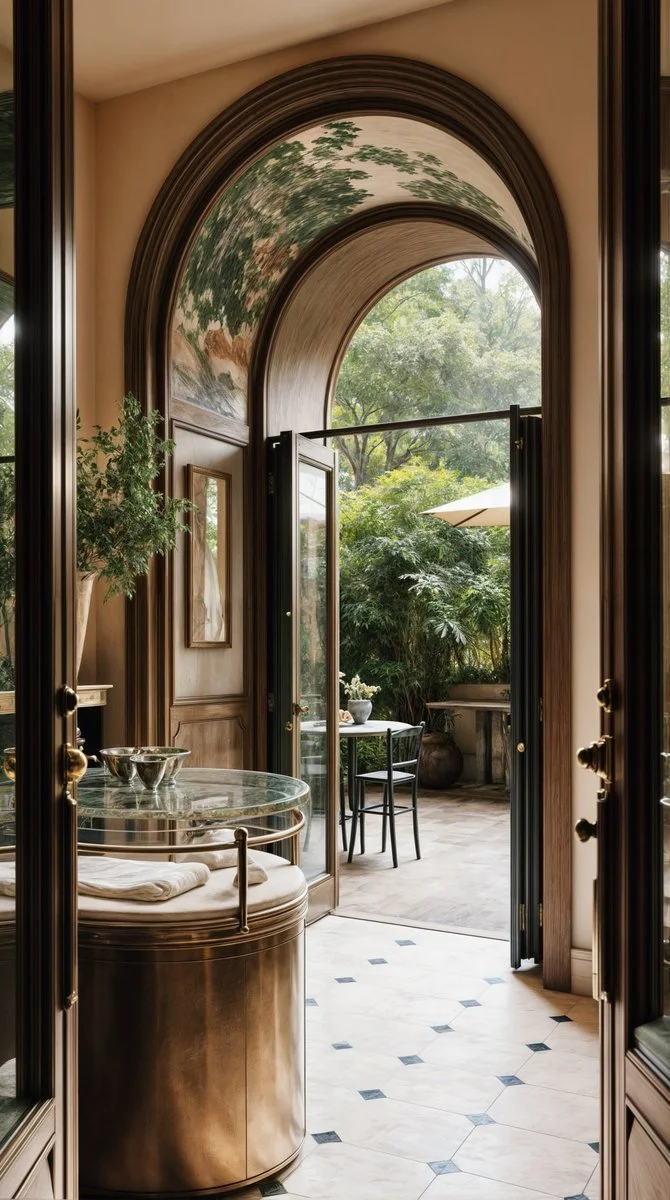
The image above — a vision of what a luxury patisserie might aspire to be — was created by designer and artist Amir Hossein Noori, whose architectural imagery has captured what the finest hospitality spaces in the world are beginning to reach for: the arched doorway with its painted ceiling detail, the brass and glass display case positioned like a jewel at the center of the room, the garden terrace glimpsed beyond the open door. It is a space that understands itself as a destination, not merely a service point. That understanding is precisely what the most forward-thinking luxury senior living communities are now beginning to build.
The croissant on the counter was laminated by hand. The pain au chocolat beside it arrived from a kitchen that takes the distinction between a viennoiserie and a pastry seriously enough to train for it. The espresso has been dialed to the preference of the barista who has been here long enough to know which resident takes it short and which takes it with a generous pour of warm oat milk.
This is not a hotel amenity. It is a residential one. And it represents one of the most significant shifts in what luxury senior living has come to mean for the generation now entering its most discerning phase.
The on-site patisserie — once the province of boutique European hotels, Michelin-recognized restaurant groups, and the most rarefied residential developments — has arrived in senior living. Not as a novelty, and not as a marketing gesture. As a genuine expression of a conviction that the people who live here have spent decades developing a palate, a preference, and a relationship with the daily ritual of something beautifully made — and that those things do not retire when they do.
WHY THE PATISSERIE IS NOT A FRIVOLITY
The instinct to treat a patisserie as a luxury add-on — pleasant, but not essential — misunderstands what it actually represents in the architecture of a resident's day. For the adults who have defined the market now entering the most premium tier of senior living, the morning pastry is rarely about the pastry itself. It is about the ritual. The fifteen minutes at a marble counter with a café au lait. The recognition from the person behind the glass case. The small, reliable pleasure of something that is exactly what it should be — which is, at its best, a form of institutional respect for the person who has spent a lifetime knowing the difference.
The research on dining and quality of life in senior communities is consistent on this point: food is among the most significant contributors to resident satisfaction, and the social context of food — where people gather, when they arrive, how long they stay — is as consequential as the food itself. A well-designed patisserie does something a formal dining room cannot: it creates an informal gathering place, a neighborhood café within the building, where interaction happens naturally and without agenda. The resident who would never linger after a scheduled dinner will spend forty minutes at a corner table when the setting is right and the coffee is genuinely good.
"A well-designed patisserie does something a formal dining room cannot: it creates an informal gathering place where interaction happens naturally and without agenda."
The award-winning dining renovation at Luther Crest in Pennsylvania — recognized as the best dining innovation of 2024 in the senior living industry — understood this explicitly. Among its seven new dining venues, the neighborhood coffee shop offering espresso and house-made pastries with café-style seating and a 24-hour grab-and-go component was among the most consistently used spaces in the building. The design team's instinct — that an informal, always-available patisserie space would become the social heart of the community — proved precisely correct.
WHAT DEFINES THE STANDARD
The word patisserie has become, in some corners of the senior living market, a marketing designation rather than a culinary one — applied to any space that sells a packaged muffin alongside an automatic coffee machine. The distinction matters, both for the resident's daily experience and for the families evaluating whether a community's culinary claims reflect genuine investment or aspirational language.
PRODUCTION
Made on-site, daily
The defining distinction of a genuine patisserie is that it bakes. Croissants laminated in-house, sourdough proofed overnight, viennoiserie shaped by a pastry team that understands the difference between a product and a craft. Delivered or frozen pastries — however high-quality — are a café, not a patisserie.
PARTNERSHIP
Chef affiliation and sourcing
The most distinguished programs are built around a named culinary relationship — a James Beard-affiliated pastry chef, a local artisan bakery partnership, or an executive pastry team with credentials that would be notable in any context. The sourcing of butter, flour, chocolate, and seasonal fruit reflects the same standards as the savory kitchen.
DESIGN
The space itself
A patisserie earns its name through physical intention — marble counters, a glass display case worthy of its contents, proper espresso equipment calibrated and maintained, seating that invites lingering. The design should communicate that this is a destination within the building, not an afterthought adjacent to the dining room.
PROGRAMMING
Seasonal and celebratory
The finest programs rotate with the seasons — galette des rois in January, hot cross buns at Easter, summer berry tarts, autumn spiced breads — and mark occasions with something made specifically for them. A birthday cake commissioned from the patisserie team carries a weight that no off-site delivery can replicate.
THE VERSAILLES INSPIRATION AND THE NEIGHBORHOOD CAFE
There are two distinct design philosophies emerging in the finest patisserie programs, and they are worth understanding as a frame for evaluating what a community is actually trying to achieve.
The first draws on the tradition of the grand European café — the elegance of a Parisian salon de thé, the refined theatricality of a Viennese konditorei, the sense that the space itself is an object of some beauty. The Noori vision captures this precisely: an arched doorway with a painted ceiling, a brass display case positioned like a jewel at the room's center, a garden terrace beyond that makes the interior feel connected to something living and seasonal. Communities pursuing this approach invest heavily in the physical environment — the millwork of the display cases, the quality of the china, the particular warmth of the lighting at a marble counter in the morning. This is a patisserie as an aesthetic statement — a room that is itself pleasurable to inhabit.
The second philosophy draws on the neighborhood café model — accessible, informal, reliably present. The 24-hour grab-and-go component. The barista who knows your order. The corner table that is understood, by convention, to belong to the resident who occupies it every morning at nine. This approach prioritizes the social function of the space over its grandeur, and it tends to produce the highest daily engagement — because it removes the formality that might otherwise limit who comes in and how long they stay.
The communities that have done this best have found ways to hold both: a space that is genuinely beautiful, and one that is genuinely comfortable. The Noori image suggests exactly that balance — grandeur without intimidation, elegance without distance. That combination is the hardest to achieve and the most transformative when it is.
NUTRITION, LONGEVITY, AND THE PATISSERIE
A natural question arises in the context of a broader conversation about longevity and senior wellness: what is the place of a patisserie in a community serious about the nutritional architecture of its residents' lives?
The answer, from the most sophisticated programs, is that the question presents a false tension. The finest patisserie programs are not operating in opposition to a community's nutritional philosophy — they are integrated with it. Whole-grain and ancient-grain breads sit alongside the brioche. Seasonal fruit tarts replace sugar-heavy confections from industrial sources. Pastry chefs trained in nutritional science bring the same ingredient rigor to a croissant that a savory chef brings to a composed plate. The butter is cultured. The chocolate is single-origin. The almond flour in the financiers is freshly milled.
A NOTE ON DAILY RITUAL
The longevity research on social connection and daily routine is consistent: predictable, pleasurable rituals — a morning coffee, a familiar face behind a counter, the particular smell of something baking — are among the most powerful contributors to psychological wellbeing in later life. The patisserie, understood this way, is not a departure from a community's wellness philosophy. It is one of its most elegant expressions.
WHAT TO ASK WHEN EVALUATING A COMMUNITY’S PATISSERIE PROGRAM
For families in the process of evaluating luxury senior living communities, the patisserie is both an amenity worth experiencing and a lens through which a community's broader commitments become visible. A community that has built a genuine patisserie program — that bakes daily, that has invested in a named culinary relationship, that has designed the space with genuine intention — has stated something about the standard it holds itself to across every dimension of the resident experience.
The questions worth asking directly: Is the patisserie producing on-site, or receiving delivered product? What is the sourcing philosophy for ingredients — butter, chocolate, seasonal fruit? Is the program affiliated with a named pastry chef, local artisan, or culinary partnership? Does the space serve a social function, or is it primarily operational? And does the menu rotate with the seasons and mark occasions in a way that makes it feel alive, rather than fixed?
A community that answers these questions with specificity and confidence has thought about what it means to build something genuinely excellent into the fabric of daily life. That is the standard Saar Advisory evaluates — and the standard every resident of a luxury community deserves to expect.
THE MORNING THAT CHANGES EVERYTHING
There is a version of a senior living transition that families approach with a quiet grief — the feeling that what is being left behind cannot quite be replaced. The neighborhood café where the barista knew the order. The Saturday morning routine of a good croissant and a newspaper at a marble counter. The small, reliable pleasures that mark a life lived with intention.
The communities that have built genuine patisserie programs have understood something important about that grief: it is not inevitable. The morning ritual, the familiar face, the pleasure of something beautifully made — these are not casualties of the transition. They are, in the most thoughtful communities, among the first things waiting on the other side of it.
That continuity — the discovery that the life continuing is not a lesser version of the one that came before, but simply a different address for the same pleasures — is the quiet ambition of everything the finest communities are building. The patisserie is, in that sense.